Friday, 26 October 2018

Color and Light Visual Perception Chapter 8+4

IS MOONLIGHT BLUE?
  • Moonlight isn't really blue.  It's actually slightly red but our visual perception tricks us into thinking that it's blue when things are dim.  
  • observe carefully when drawing in moonlight so not to be deceived. 

EDGES AND DEPTH 
  • painterly control of blurriness, especially along the boundary of the form.  
  • Edges give a sense of depth 
  • Depth of field-- keep the background out of focus 
  • Intersecting contours-- different focus shows different planes 
  • edges in moonlight-- less sharp edges at night
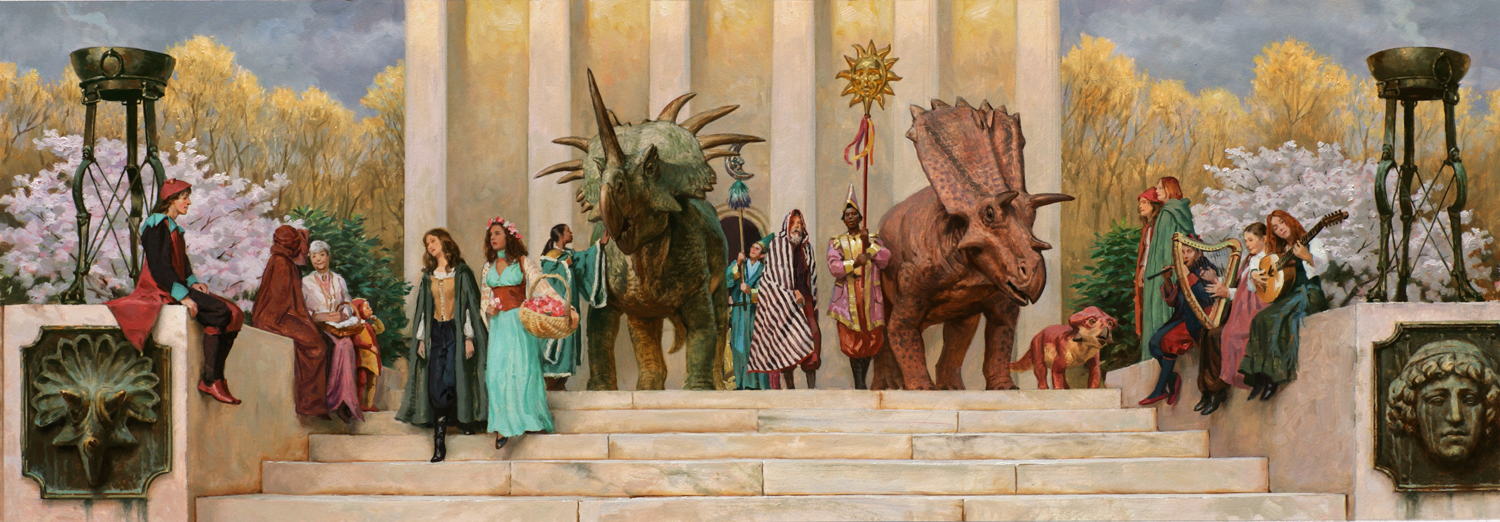
Image result for giant rodent dinotopia

COLOR OPPOSITIONS
  • complements mimic natural opposites like fire and ice.  Use complements to show contrast and direct the eye.  one complement brings out the other 

COLOR CONSTANCY 
  • We interpret local colors as stable and unchanging regardless of the effects of colored illuminations etc.  

ADAPTATION AND CONTRAST
    Image result for complements painting
  • Colors are affected by other colors 
  • Cool Light and Warm Shadow 
    • having both warm and cool keeps things looking natural 
  • Simultaneous contrast: The Hue, saturation or brightness of a background color can produce the opposite qualities in the object sitting in front of it 
  • Successive contrast: looking at one color changes the next color we see 
  • Chromatic adaptation: our visual system becomes accustomed to a give color of illumination.  When the illumination changes, our eyes adjust accordingly. 
  • Color constancy: local colors appear consistent, regardless of lighting circumstances
  • Size of the objet: the smaller a colored object becomes, the less distinct the color looks.  
APPETIZING AND HEALING COLORS 
  • Certain colors promote healing, the appetite etc.  
  • Healing colors: avoid red and yellow 
  • appetite: warm, bright colors.  IE McDonalds

ELEMENTS OF COLOR 

CHROMA AND VALUE 

  • when painting from direct observations, tones are translated and wont be exact.  That's okay
  • Peak chroma value is where a given hue reaches its greatest chroma.  blue is most intense when dark, red is most intense at it's middle brightest.  


LOCAL COLOR
  • Local color is the color of the surface of an object as it appears close up in white light 
  • usually when mixing for a painting, the colors you mix will vary from the precise local color which is supposed to happen
GRAYS AND NEUTRALS
  • Grays and neutrals are opposites of intense colors 
  • more paintings fail from using too much intense color than too much gray
  • gray provides a setting for bright accents.  
THE GREEN PROBLEM
  • the human eye is most sensitive to yellow green wavelengths 
  • use blues to balance it out it will still look green 
  • make green by mixing yellow and blue not straight green pigment 
  • vary your mixtures 
  • Have a pink or reddish background and paint on top green.  this is called Smuggling reds
GRADATION

  • gradual shift of color.  Looks pretty in the sky 

TINTS 
  • Adding white to a color raises the tint making it pastel.  These convey a feeling of light 


Friday, 19 October 2018

Color and Light- Color Relationships Chapter 6

MONOCHROMATIC SCHEMES

  • A color scheme composed of any single hue taken from a range of value or chroma 
WARM AND COOL 
  • COOL FAMILY PIECES
    • suggest mystery, darkness, or gloom 
    • develop interest by adding warm color notes 
Image result for cool color painting renaissance
  • WARM FAMILY PIECES
    • Romantic, exotic, happy 
Image result for Warm color painting renaissance


COLORED LIGHT INTERACTIONS 
  • Two different colored lights mix to make a new color.  
TRIADS
  • A triadic scheme is composed of any three basic colors but not necessarily full chroma colors
Image result for Samarian steps dinotopia

COLOR ACCENT
  • Spice up a gray piece with a little dash of color  
  • can attract the eye to where you want the interest to be 
  • any small area of color noticeably different than the rest. 

Image result for escape from poseidos dinotopia

Friday, 5 October 2018

Color and Light - Sources of Light Chapter 2

SOURCES OF LIGHT

DIRECT SUNLIGHT

  • Three illuminations on sunny day: the sun, blue sky and reflected light from illuminated objects. 
  • Sunlight is the brightest light source 
  • Blue sky can mess with colors a bit 


OVERCAST LIGHT
  • layer of clouds diffuses sunlight 
  • Contrast is lower 
  • Ideal for complicated scenes 


WINDOW LIGHT 
  • Constant with simplifying effect 
  • Unless sun shining directly through window daylight is usually blueish 
  • Contrasts with warm artificial lights
  • Floor and ceiling get reflected colors from sky and ground outside 


CANDLELIGHT AND FIRELIGHT 
  • yellow orange 
  • Fairly weak 
  • Noticeable after sunset 
  • Leave no deep darks around light 
  • Weaken the light— fall off 


INDOOR ELECTRIC LIGHT 
  • Keep in mind relative brightness, hardness or softness, color cast 
  • Consider the brightness of the lamp 
  • Hard light comes from a small sharp point 
  • Soft light larger, farther away source 
  • Color cast consider the bulb color it will affect the room 


STREETLIGHTS AND NIGHT CONDITIONS 
  • before late nineteenth century, two colors of light at night, moonlight which is blue or gray and orange flame based light.  Electric lights brought new colors
  • Moonlight can contrast with warm shop and city lights 
  • Sodium vapor orange 
  • mercury vapor cooler color 

Image result for anaheim glow painting

LUMINESCENCE

  • When hot or flaming objects give of light its Incandescence.  But glowing at cool temperature is LUMINESCENCE
  • bioluminescence organisms that produce light.  Mostly in the ocean.  
  • Fluorescence is a light produced by an object that converts invisible electromagnetic energy.  Some minerals give this off when lit by ultraviolet light
  • Tips and Techniques 
    • luminescent colors change from one hue to another 
    • blue green colors common in ocean bc travel through the water best. 
    • Paint the scene first in darker tones without the luminescence and then add glow 
Image result for Golden caverns painting dinotopia

HIDDEN LIGHT SOURCES


  • A light inside the scene that's concealed from view
  • mysterious
  • different colors add to mystery 

Graphic LA - pgs 96-143


  • DRAW NOW JUDGE LATER
  • BLACK AND WHUTE TRUTHS:
  • Thumbnail it out 
  • 30-70 ratio mostly dark or mostly light
  • En made perspective 
  • Contour/isoparms form understanding 
  • Bold shapes 


  • Steps: rough sketches looking for composition, shape design, assigning color, adding foreground, more details 

  • Then modeling form, erasing edges, details and adjustments, finding the form  in the clouds 


Final stages: adding detail, refining edges refining shapes adjusting color and values adjusting atmosphere 


THINGS TO FIND: 
3 main shapes
3 main values 
3 main levels 
Find the best and simplest arrangement of these

Keep your mind less tense and more curious. 


Color and Light - Premixing Chapter 7

MIXING COLOR STRINGS A color string is a group of prepared paint blobs of a given hue mixed with a palette knife in a set of steps from l...