Friday, 14 December 2018

Color and Light - Premixing Chapter 7

MIXING COLOR STRINGS

  • A color string is a group of prepared paint blobs of a given hue mixed with a palette knife in a set of steps from light to dark.  
  • saves time to prepare before you start painting 

GAMUT MAPPING 

  • The entire group of possible colors for a painting is called the gamut.  
  • the gamut for a triadic scheme would be a triangle 
  • start with parent colors everything you mix will come from them.  
  • You can mask over a painting with gamut colors to unify it even more 
SHAPES OF COLOR SCHEMES 


The most common shape is the triangle 
hues directly next to each other are harmonious 

MIXING A CONTROLLED GAMUT 
  • remove tube colors 
  • try not to mix too many after initial mixing plan 

COLOR SCRIPTING 
  • Sequential art needs to consider previous and future color schemes as a whole 
  • consider the change in color schemes and what it means 


Friday, 7 December 2018

Color and Light - Paint and Pigments Chapter 5 pgs 96-99, 104-107

WARM UNDERPAINTING

  • instead of beginning a painting on white canvas sometimes artists pretone the painting
  • a warm underpainting is good for skies or foliage or anything with major blue or green 
SKY PANELS 
  • prepare a panel with a sky gradation as a base layer for the future painting 
  • paint the sky gradient then the details on top.

LIMITED PALETTES 
  • keep your color palette simple to create a more unified piece 


Friday, 16 November 2018

Color and Light - Atmospheric Effects Chapter 10 + 11

SKY BLUE

  • The sky is not a flat even blue 
  • looking in the vicinity of the sun much more golden green 
  • looking away from sun much cooler, purple blue 
  • sky gets lighter near the sun 
ATMOSPHERIC PERSPECTIVE

  • objects at a distance are brighter and dimmer because of all the atmosphere between you and them 
  • Warm colors advance, cool colors recede 
REVERSE ATMOSPHERIC PERSPECTIVE 
  • cool colors advance, warm colors recede 
  • rare
GOLDEN HOUR LIGHTING 
  • at dawn and at dusk 
  • colors become bold and dramatic because sun shines through an ocean of air 

SUNSETS

  • if the air is full of moisture and dust, red and yellow clouds 
  • light hitting clouds remains relatively white compared to light hitting the ground 

FOG MIST SMOKE DUST 
  • contrast drops 
  • soft cast shadows 
  • blue illumination from the sky 
SKY HOLES AND FOLIAGE 
  • when painting leaves use selective detail 
  • kinda like hair 

SUNBEAMS AND SHADOWBEAMS 
  • sunbeams are shafts of light made visible in dust or moisture from the atmosphere  
  • they have to go through something 
  • shadow beams occur most often when a jet contrail aligns with the line of sight 
DAPPLED LIGHT 
  • as sunlight passes through upper leaves it leaves dappled pattern in the shadows 
  • spaces between leaves act as pinhole projectors
  • if sun was eclipsed little eclipsed shapes 
CLOUD SHADOWS 
  • Passing clouds interrupt the sun 
  • shadow area is darker and cooler than sunlit area but not as much of a blue cast because light entering shaded area is average of blue light and white light from cloud layer 
  • soft edge 
  • size and spacing matches the clouds in the sky 
SNOW AND ICE 
  • pick up more shadow color and light 
WATER REFLECTION AND TRANSPARENCY 
  • can see through the water better closer to you than farther away 
  • darks reflect on water too.  depends on how dirty the water is how they show up 
  • cast shadows not over deep clear water 
  • cast shadows do go over deep dirty water 

COLOR UNDERWATER 

  • water filters selective colors, leaving a blue cast 
  • various impurities can discolor the water 


Friday, 9 November 2018

Color and Light - Surfaces and Effects Chapter 9

SURFACES AND EFFECTS

TRANSMITTED LIGHT

  • When sunlight travels through a thin, semitransparent material, the light becomes reichly colored

SUBSURFACE SCATTERING 
  • light enters the skin or any translucent material and spreads out beneath the surface, creating a glow 
COLOR ZONES OF THE FACE 
  • Complexion of a light skin face divides into three zones 
    • forehead is light golden 
    • the brow to bottom of nose is reddish 
    • the bottom of nose to bottom of chin is bluish 

THE HAIR SECRET 
  • use big brushes 
  • blend where it meets the forehead 
  • soften edges 
  • control and design highlights 
  • keep masses simple 
  • think ribbons 


SPECULAR REFLECTIONS

  • objects with a shiny surface are like mirrors.  It reflects images of whatever is around it 
  • specular reflection has light rays that bounce off the surface at the same angle they approached it 
  • diffuse reflection matte surface 
HIGHLIGHTS


  • specular reflections on wet or shiny surfaces 
  • perpendicular to the light 
  • not pure white

COLOR CORONA 

  • when an extremely bright source such as a setting sun or streetlight is surrounded by a region of colorful light 
  • lens flare 
MOTION BLUR
  • blurring to suggest rapid movement 

PHOTOS VS OBSERVATION 

  • references are good but paint from observation to best record color 


Friday, 2 November 2018

Color and Light - Light and Form Chapter 3

LIGHT AND FORM

THE FORM PRINCIPLE

  • the form principle is the analysis of nature in terms of geometrical solids, which can be rendered according to laws of tonal contrast 
  • matte surfaces can alter this, less of an effect 
  • MODELING FACTORS
    • In direct sunlight, there's a strong division of light and shade.   
    • modeling factors are the set of tonal steps from light to shadow based on the level of light
  • THE TERMINATOR 
    • where light turns to shadow 
    • texture can be difficult to see in the shadow region 
  • CORE OF THE SHADOW 
    • Area just beyond the terminator
  • DIFFUSE LIGHT 
    • no distinct light or dark side or terminator 

SEPARATION OF LIGHT AND SHADOW 
  • sometimes the darkest dark might be a "white" object.  it all depends on the relative lighting 
CAST SHADOWS
  • When a form intercepts a parcel of direct light, it projects or casts a shadow onto whatever lies behind it.  
  • THE EYEBALL ON THE ANT
    • imagine yourself as an eyeball on the back of an ant.  look up and walk across a shadow and notice the light sources.  all of the light and colors will affect the shadow.  
  • THE LIGHT AND THE SHADOW EDGE 
    • the nature of the cast shadow is closely related to the nature of the light source. 
      • hard light- sharp edge
      • soft light- blurry edge
      • side by side lights- side by side shadows 
  • the edge of a shadow gets softer farther away from the source 
HALF SHADOW 
  • creates drama 
OCCLUSION SHADOWS 
  • dark accents appear where forms come close together leaving a dense area of shadow
  • grounds things, make sure they don't float 
THREE QUARTER LIGHTING 
  • good for portraits 
  • also called broad lighting 
  • emphasizes the near side of the face 
  • flattering and unobtrusive
FRONTAL LIGHTING 
  • light that shines directly toward a model from the viewers perspective.  
  • emphasizes two dimensional design instead of three dimensional form 
EDGE LIGHTING 
  • comes from behind and touches the sides.  
  • strong source of light 
  • very dramatic effect 
CONTRE JOUR 
  • contre jour lighting is a type of backlighting where a subject blocks out the light 
  • white light spills over the sides 


LIGHT FROM BELOW 
  • unusual 
  • has a theatrical effect 
REFLECTED LIGHT 
  • shadows are affected by reflected light.  IE. shirt color on the chin and cheek 

SPOTLIGHTING 
  • also dramatic 
  • everything but the area in the spotlight falls out of detail and into shadow 


Friday, 26 October 2018

Color and Light Visual Perception Chapter 8+4

IS MOONLIGHT BLUE?
  • Moonlight isn't really blue.  It's actually slightly red but our visual perception tricks us into thinking that it's blue when things are dim.  
  • observe carefully when drawing in moonlight so not to be deceived. 

EDGES AND DEPTH 
  • painterly control of blurriness, especially along the boundary of the form.  
  • Edges give a sense of depth 
  • Depth of field-- keep the background out of focus 
  • Intersecting contours-- different focus shows different planes 
  • edges in moonlight-- less sharp edges at night
Image result for giant rodent dinotopia

COLOR OPPOSITIONS
  • complements mimic natural opposites like fire and ice.  Use complements to show contrast and direct the eye.  one complement brings out the other 

COLOR CONSTANCY 
  • We interpret local colors as stable and unchanging regardless of the effects of colored illuminations etc.  

ADAPTATION AND CONTRAST
    Image result for complements painting
  • Colors are affected by other colors 
  • Cool Light and Warm Shadow 
    • having both warm and cool keeps things looking natural 
  • Simultaneous contrast: The Hue, saturation or brightness of a background color can produce the opposite qualities in the object sitting in front of it 
  • Successive contrast: looking at one color changes the next color we see 
  • Chromatic adaptation: our visual system becomes accustomed to a give color of illumination.  When the illumination changes, our eyes adjust accordingly. 
  • Color constancy: local colors appear consistent, regardless of lighting circumstances
  • Size of the objet: the smaller a colored object becomes, the less distinct the color looks.  
APPETIZING AND HEALING COLORS 
  • Certain colors promote healing, the appetite etc.  
  • Healing colors: avoid red and yellow 
  • appetite: warm, bright colors.  IE McDonalds

ELEMENTS OF COLOR 

CHROMA AND VALUE 

  • when painting from direct observations, tones are translated and wont be exact.  That's okay
  • Peak chroma value is where a given hue reaches its greatest chroma.  blue is most intense when dark, red is most intense at it's middle brightest.  


LOCAL COLOR
  • Local color is the color of the surface of an object as it appears close up in white light 
  • usually when mixing for a painting, the colors you mix will vary from the precise local color which is supposed to happen
GRAYS AND NEUTRALS
  • Grays and neutrals are opposites of intense colors 
  • more paintings fail from using too much intense color than too much gray
  • gray provides a setting for bright accents.  
THE GREEN PROBLEM
  • the human eye is most sensitive to yellow green wavelengths 
  • use blues to balance it out it will still look green 
  • make green by mixing yellow and blue not straight green pigment 
  • vary your mixtures 
  • Have a pink or reddish background and paint on top green.  this is called Smuggling reds
GRADATION

  • gradual shift of color.  Looks pretty in the sky 

TINTS 
  • Adding white to a color raises the tint making it pastel.  These convey a feeling of light 


Friday, 19 October 2018

Color and Light- Color Relationships Chapter 6

MONOCHROMATIC SCHEMES

  • A color scheme composed of any single hue taken from a range of value or chroma 
WARM AND COOL 
  • COOL FAMILY PIECES
    • suggest mystery, darkness, or gloom 
    • develop interest by adding warm color notes 
Image result for cool color painting renaissance
  • WARM FAMILY PIECES
    • Romantic, exotic, happy 
Image result for Warm color painting renaissance


COLORED LIGHT INTERACTIONS 
  • Two different colored lights mix to make a new color.  
TRIADS
  • A triadic scheme is composed of any three basic colors but not necessarily full chroma colors
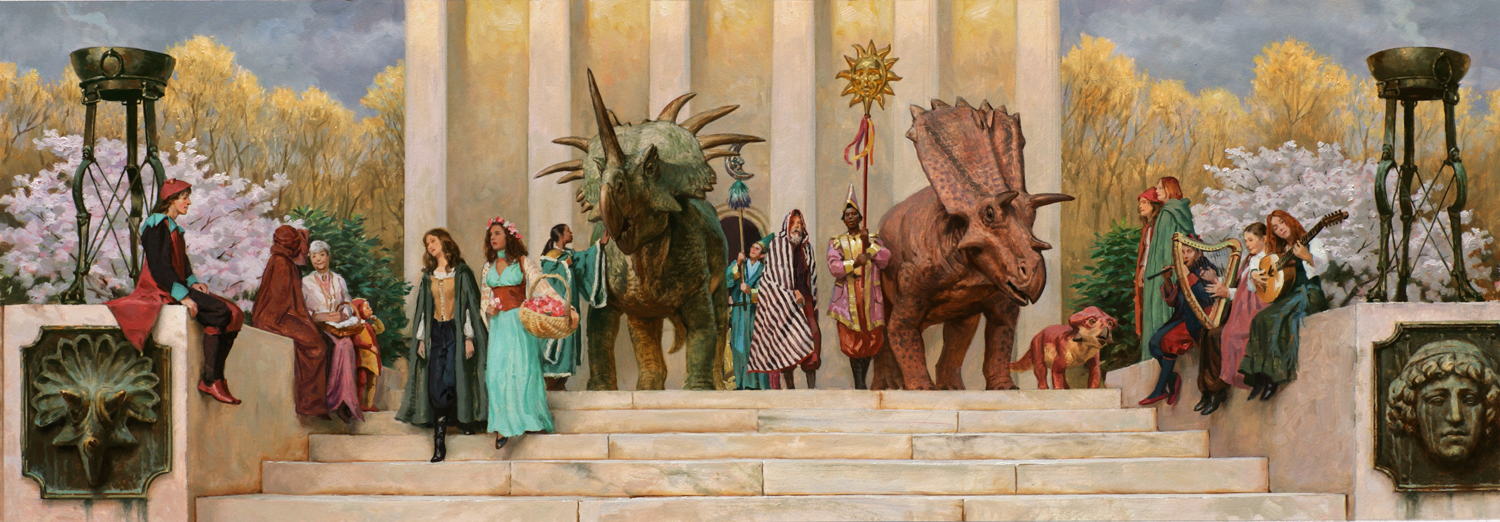
Image result for Samarian steps dinotopia

COLOR ACCENT
  • Spice up a gray piece with a little dash of color  
  • can attract the eye to where you want the interest to be 
  • any small area of color noticeably different than the rest. 

Image result for escape from poseidos dinotopia

Color and Light - Premixing Chapter 7

MIXING COLOR STRINGS A color string is a group of prepared paint blobs of a given hue mixed with a palette knife in a set of steps from l...